Trees, Qiblas, and Stars
Where in the world are we praying today?
“Why would you guys pray to trees?” — My American Dad
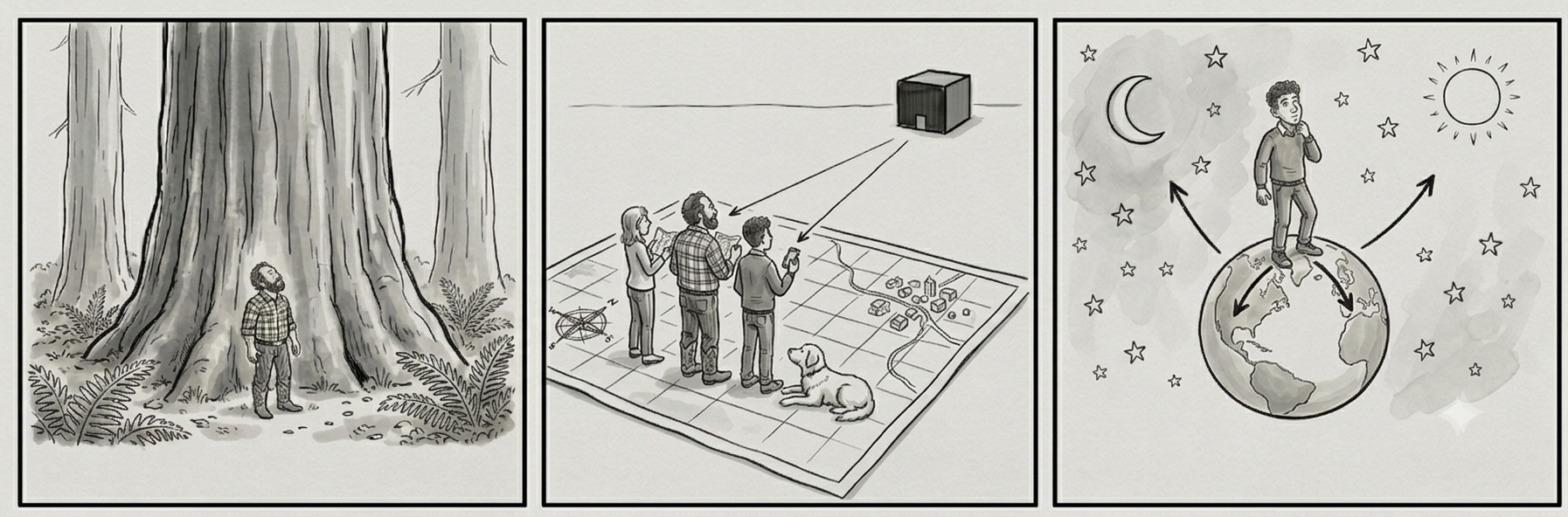
The question stunned me for a moment. I didn’t realize he was joking. He’d seen a small group praying by the roadside, and since this was in northern California amidst the redwoods, they were in front of a towering tree as they prayed. The real question was: why were they facing the tree? Why do Muslims pray in a very specific direction? And those are much deeper questions than they seem.
The obvious answer is that Muslims pray towards Mecca, specifically towards the site of the Kaaba (the holiest site in Islam, a sacred cube-shaped building, and perhaps a story for another day about another question). That direction is called the qibla in Arabic. But why any specific direction at all? It’s tempting to chalk it up to an arbitrary choice, and say “well, we had to pick some direction, right?” And choosing a direction that leads to the holiest site in Islam seems like a good choice, and helps keep group prayers and mosques more organized. But there’s more to it than that.
If we compare Muslim prayers to Christian prayer services, the uniformity of direction seems obvious. Just like having a priest or a pastor lead a group in prayer, Muslim prayers at a mosque would commonly have an imam leading the prayers, and he might also be the khateeb delivering a sermon on special days like Friday (which is literally called gomaa, a word evoking gathering, in Arabic, and is the day Muslims tend to pray at the mosque and hear a sermon). This uniformity of experience and ritual, and the uniformity of the direction, and the knowledge that others elsewhere are looking towards the same qibla, is a powerful reminder that we’re not alone in this world, and that we have a responsibility towards others.
I could cite how the experience of Hajj (the Muslim pilgrimage to the Kaaba in Mecca) affected Malcolm X — how impressed he was with a pilgrimage towards the qibla, and a ritual that levels people from different backgrounds by requiring simple clothing for its completion, and brings them together for the same sequence of prayers and activities. But while that’s probably the simplest explanation for why there’s a common direction of prayer, and it does have the advantage of seeming particularly practical for group prayers, there’s a deeper unifying message along those lines.
A less-than-obvious significance of that specific direction is that its choice is viewed as an act of divine mercy, making it a continuous reminder of that particular kindness. To understand how, we first need to realize that the qibla was not always towards Mecca. It was originally towards the “furthest” mosque in the city of peace, the Ur Shalim, Jerusalem. But Muslims believe that divine revelation allowed the first Muslims to pray towards the Kaaba instead. That this revelation happened at a mosque in Medina meant that that particular mosque technically has two prayer niches (mehrabs). While all subsequent mosques had their prayer niches, indicating the qibla, in the direction of Mecca, the fact that a qibla could be changed, that an alternative direction could be permitted, is a powerful message.
In a particularly good Egyptian song the singer has a line that describes this change in direction by saying “even God, to make his worshipper happy, made the Kaaba a qibla.” Aside from the obvious reference to free will, and the freedom to change a path, the song is a protest against theocratic authoritarianism. It’s called Fe Ekhtelafna Rahma (the title means “in our differences there is a mercy,” a principle in Islamic jurisprudence that is supposed to invite diverse opinions), and it eloquently argues for why it’s important to accept our differences, and harshly admonishes the kind of extremists who demand conformity to their singularly intolerant way of seeing things (by pointing out that even the almighty didn’t demand that of us, showing their cruel intolerant faux-piety for the blasphemous arrogance it is).
So the qibla is a practically and spiritually useful reminder. A reminder that we’re not alone in our specific form of prayer, even though there are variations even in that. We are not alone in our differences or in what makes us alike, and we need not all be facing in the same direction to be worthy.
And that’s all lovely, but sadly Muslims are not immune to bigots and performative piety. And while there are countless examples of angry long-bearded extremist “clerics” who never seem to tire in finding ways to make people feel bad, there was one cheerful character who (with presumably the best of intentions) managed to find delight in being the local self-appointed prayer-police, catching worshippers who were doing it even slightly “wrong.” It was on a news program covering a small Muslim community (in Texas of all places), and one particularly cheerful member proudly explained how she was a recent convert, but felt that she fit right in. She then proceeded to explain how she really got the religion, and how she’d even have to correct the mistakes of members of the community who still managed to get it wrong, even though they’d been raised Muslim. The pride she found in pouncing upon any poor member of the congregation who didn’t perform the prayers as she believed they should be, was truly something to behold. Cheerful, yes, but also obliviously arrogant, intolerant, and heartbreakingly misunderstanding so very very much. There she was, pointing at people trying to pray, and gleefully seeking any deviation from the direction she knew they should be following, and completely unaware how terribly cruel that was.
Had she heard that song, or been taught the story of how the Prophet’s grandsons noticed a man making a mistake in the way he prayed, she might not have found so much pleasure in being right. In case you’re wondering, the story of the Prophet’s grandsons was that they just made a point to prepare to pray as they normally did within sight of the man, and left it to him to notice the difference. What they pointedly did not do was publicly correct him, lest that hurt his feelings.
But spiritual metaphor and historical reminder aside, there’s another significance to a specific direction of prayer. A geographic and astronomical one.
Churches and temples of different kinds are often built in very specific orientations. Whether it’s mission churches in California, or Pharaoh’s temple, orientation and direction can carry significant meaning. But also like those two examples, there’s a link to the heavens, and to the sun in particular.
But by picking a specific point on the globe to which to pray, we run into a problem when we realize we’re standing on a planet. And that wherever we are on earth, there are at least two directions to Mecca (and if we’re at the antipode of Mecca, sailing in French Polynesia perhaps, every way we look is towards Mecca). So the choice of direction demands an understanding of where we are on the globe, so that we might know which is the nearest way to Mecca. And when we pair the qibla with the knowledge that we face this direction for each of the five prayers of the day, and what those prayers are, we can answer a very clever question indeed.
To give you an idea of just how brilliant My American Dad is, here’s one very clever question he once asked his students (he would do this sort of thing to encourage us to think critically and holistically about problems):
You wake up and have no idea where you are. You recognize no landmarks or terrain around you, and have no memory of how you got there. You find that you have a box with one item in it, a watch, and a note. The note says “this watch tells you date and time, is perfectly accurate, and is set to the local time at the Greenwich observatory.” With this precise clock that tells you Greenwich Mean Time, how can you figure out where you are on earth?
If you’re a Muslim who understands the qibla and prayer times, you’d be able to easily solve this. You don’t have to know where the qibla is, you could figure it out (by figuring out where you are) using only the watch, and knowledge of how prayer times are affected by your location.
For longitude, you just need to know the time. That was a long-standing practical problem, famously solvable if you had a way of knowing the difference between the time at a specific location, and when you see the sun reach its highest point at your location. So the precise GMT watch is all you need for longitude, but what about latitude?
The five main prayer times are: sunrise, noon, afternoon, sunset, and night. All but afternoon are obviously tied to the observable position of the sun. Afternoon is also calculated based on the sun, specifically based on the length of a shadow in relation to the height of the object casting it. But knowing that, and being aware of how your location affects how you pray, easily gives you latitude. Knowing that the difference between sunset and dusk/night is almost non-existent at the equator, means that being at the equator makes it hard to separate those two prayer times. Being near the poles makes the difference between sunrise and sunset very difficult for fasting in Ramadan, and a very obvious problem for Muslims living near the Arctic Circle. All this means that an awareness of the nature of prayers and their uniform direction gives you a sense of how they vary based on your location on the globe. This means that you should be able to figure out your latitude by noting how much time elapses between two prayer times (as indicated by the sun). The difference in time between night and sunrise will tell you which hemisphere you’re in. So now you know your approximate latitude and longitude. Congratulations. You’ve found yourself.
Or to put it another way. We don’t pray to trees. But it’s all too easy to miss the forest if we focus on just our tree. It’s helpful to remember why we pray the way we do, and all too easy to be cruel if we just accept our way as the only way. It’s far better to think and keep an open mind, and to feel free to ask the question even if it seems obvious, than it is to try to force others to follow your way.
There’s more than one direction.